Shopify
When Is Your Shopify Store Ready for the Next Stage of Growth?
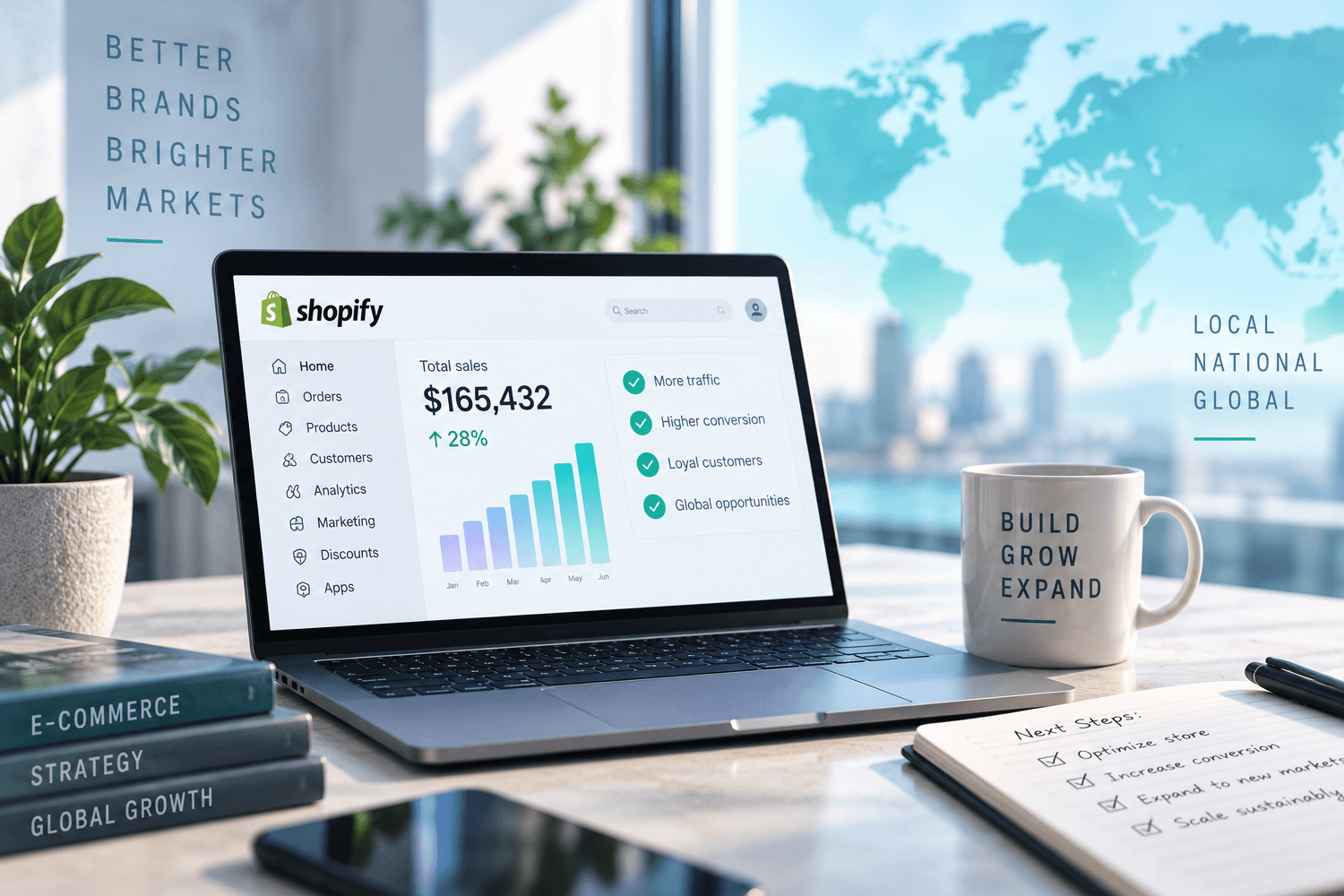
When Is Your Shopify Store Ready for the Next Stage of Growth?
Growth isn't simply getting more traffic. A store needs the operational and technical foundation to handle that growth.
What “Ready for growth” means is that your business systems can withstand the project growth you are seeking. You have developed your supply chains and warehousing systems to peek efficiency where Shopify and Google are displaying high rates of successful orders, reviews reflect superior service, and you have a low chargeback rate (less than 1%).
Beyond the main infrastructure efficiency, your product placement and pricing mechanisms respond quickly to change and competitor challenges. Your marketing and operations teams can pivot during political issues such as tariffs, trends in product popularity, or lack thereof, and your teams react in lockstep with these business changes.
"When the foundational structure of your business is operating at peek efficiency, your business will start to crave growth. Whether that’s in customer readiness, employee insights, or general business insight, reaching for growth can mean many things."
Growth may mean adding operational layers to your domestic market or market entry into a global market. Whichever you decide to choose, this means that your business must be ready for the following:
Develop resources (people, money, time).
Decentralize domestic market into targeted regions or research a global market for entry.
Invest in product placement, product mixes, pricing mechanisms, regional or global distribution channels, and new marketing campaigns.
Familiarize yourself with regulatory, political, and/or technological changes that have opened new pathways to new markets.
Expand your current Shopify setup for growth.
Has your business outgrown it’s current Shopify setup?
Your Shopify store may have outgrown its original setup if your customer base has grown to a point that a more complex operation is needed. Your website theme, loyalty program, pricing mechanisms, email marketing, and other app setup may require a more complex setup.
Signals:
Your orders have increased to a level that will benefit from lower fees at a larger subscription tier.
Current currency, languages, and checkout do not reflect expanding customer base.
Blind spots in data cause a failure to show true profitability, customer lifetime value, and/or repeat customer drivers.
Current setup causes inventory and order bottlenecks, such as manual notes for split shipments, backorders, or B2B requests.
Customers are asking for different products or more product information.
Your Shopify setup can handle a more complex business
Given you have met the signal challenges to e-commerce growth, then your business will be able to handle a more complex setup.
Manual processes have evolved into complex operations, supply chain, marketing, and reporting.
Pricing mechanisms respond well to market volatility, competition, exchange rate fluctuations, and tariff changes.
Reporting structures inform you rather than confuse you. Weekly, monthly, quarterly, and yearly analytics and reporting assist your business strategy.
Inventory, warehousing, fulfillment, and shipping capacity boost productivity as efficiency improvements create positive outcomes.
Tech stack is less messy, costs are reduced, and app efficiency is increased while redundancy is reduced.
You understand what's driving your growth
Your business strength allows you to understand the complexities with operations, supply chain, and marketing. A more complex business structure means each department becomes more complex.
Domestic Growth vs Global Growth
Both domestic and global markets provide opportunities for growth. Depending on your business complexity, you may choose to decentralize your business operations within Canada or go global. Choosing your growth option depends on how you want to grow, what stage of growth you are at, and which markets (domestic or global) you want to enter.
Domestic growth within Canada will require stacked shipping, marketing, and operations. Your marketing may change depending on the province, consumer personas, willingness-to-pay, normal and inferior products, economic fluctuations, as well as social, regulatory, and technological changes.
Global growth requires similar adaptations; however, your products will require additional complexity:
Delivery Duty Paid (DDP) for global trade, seen automatically at Shopify checkout.
A standardized product identification system (Harmonized System Codes) that informs the Shopify checkout to show the correct duty to be paid.
Research and Development:
Global trade research.
Global market entry.
Global trade law.
Global trade finance.
Global operations and supply chain.
Global marketing.
Global communications and culture.
Google transformation:
Google Merchant Center product feeds per market.
Google Ads campaigns per market.
Google Analytics (GA4) per market.
Omnichannel setup
Regulatory adherence and insurance:
World Customs Organization (WCO).
World Trade Organization (WTO).
Export Development Canda (EDC).
World Intellectual Property Organization (WIPO).
International Chamber of Commerce (ICC).
Alvalara.
Shipping transformation
Canada Post and Shopify negotiated rates.
Stacked shipping rates per market.
Does growth expose weakness?
You may want to grow your business too quickly and risk exposing your business to decline. If you have not built a strong foundation for your business and begin growth in your domestic market or in a global market, but your original business sales experienced decline over time, you may need to refocus your strategy.
This refocus may include redirecting resources to fixing the foundation. Costs across your staff, product mix, apps and integrations, and other business activities.
A GAP analysis will help give you insight before you experience this form of business weakness:
Business Area | Gap to Address |
|---|---|
People & Operations | Capacity, training, and process improvements |
Product & Inventory | Inventory planning and product strategy |
Technology & Apps | Automation and integration |
Marketing | Channel growth and measurement |
Data & Analytics | KPIs and attribution |
Fulfillment & Shipping | Logistics, rates, processes, and capacity |
Customer Experience | UX, merchandising, and service improvements |
Market Expansion | Feasibility and market-entry planning |
Start selling now
Ready to expand your business globally?



Start selling now
Ready to expand your business globally?
Start selling now
Ready to expand your business globally?